Spravato for Treatment-Resistant Depression
When standard oral regimens fail to lift an ongoing depressive episode, adjusting your therapeutic strategy becomes essential. Chronic emotional numbness, severe executive dysfunction, debilitating lethargy, fragmented sleep, and persistent cognitive clouding can disrupt professional commitments and personal stability.
Spravato for treatment-resistant depression represents an established, FDA-approved pharmacological intervention designed specifically for adults who have not found relief from oral medications. At Modern Mind Clinic, every esketamine session is delivered within a certified clinical setting, featuring structured pre-dose assessments and continuous post-administration medical observation.
REMS-Certified SPRAVATO® Treatment Center in Southfield, MI
Response rate observed in adult clinical trials evaluating esketamine plus oral antidepressants for treatment-resistant depression (PubMed).
Diagnostic threshold required by clinical guidelines to confirm an inadequate response during the current depressive episode (PubMed).
Standard single-use nasal device dose utilized to build 56 mg and 84 mg treatment sessions (PubMed).
Minimum post-administration observation window required under federal REMS safety protocols (NCBI Bookshelf).
Understanding Treatment-Resistant Depressive Illness
Treatment-resistant depression (TRD) describes a persistent major depressive state that does not improve after completing adequate trials of standard antidepressants.

While specific diagnostic frameworks vary slightly across clinical practice, consensus criteria define treatment-resistant depression by the absence of significant clinical response after completing at least two separate antidepressant regimens administered at therapeutic doses and durations.
Experiencing TRD does not mean a depressive episode cannot resolve. Rather, it indicates that traditional monoaminergic pathways have proven insufficient and that a biologically distinct psychiatric approach is required.
Spravato introduces an alternative therapeutic mechanism. Operating as an NMDA receptor antagonist, it offers an FDA-approved option for eligible adults facing difficult-to-treat depression, prescribed either alongside an oral agent or as a standalone monotherapy.
Clinical Candidacy and Patient Eligibility
Eligibility for Spravato for treatment resistant depression depends on comprehensive psychiatric profiling rather than symptom severity alone. Our medical team conducts structured evaluations to confirm candidacy:
A patient may be considered a candidate for clinical esketamine therapy if they demonstrate:

A verifiable diagnosis of major depressive disorder meeting the threshold for treatment-resistant depression.
Documented history of inadequate clinical response or severe intolerance to two or more conventional oral antidepressants.
Medical clearance confirming absence of vascular vulnerabilities, severe aneurysmal disease, or uncontrolled baseline hypertension.
No current substance dependence or medical contraindications that could heighten esketamine risks.
Full logistical readiness to complete the 120-minute post-dose observation period and adhere to the strict prohibition against operating vehicles post-session.
Following FDA labeling expansions, Spravato is approved both as an adjunct to ongoing oral antidepressants and as monotherapy for adult treatment-resistant depression. This regulatory update provides critical clinical flexibility for individuals unable to tolerate standard oral medications.
Daily Life Impacts of Persistent Depression
Unremitting depressive episodes affect systemic physical well-being, interpersonal engagement, and daily functional output:
Symptom Domain
Persistent Low Mood
Pervasive Anhedonia
Chronic Lethargy
Executive Dysfunction
Circadian Disruption
Pervasive Guilt
Avolition
Interpersonal Isolation
Everyday Functional Obstacle
Enduring emotional heaviness and profound sadness unresponsive to baseline pharmacotherapy.
Total absence of emotional reward or enjoyment from career milestones, hobbies, and personal relationships.
Exhaustion that makes maintaining basic personal routines, employment, or domestic upkeep feel impossible.
Significant indecision, memory lapses, and reduced mental stamina that impede workplace performance.
Intractable middle-of-the-night insomnia, delayed sleep onset, or persistent non-restorative hypersomnia.
Destructive internal criticism, excessive self-reproach, and perceived inadequacy that deepen depressive withdrawal.
Psychological and physical paralysis that turns routine responsibilities into overwhelming hurdles.
Detachment from social circles, friends, and family units caused by severe emotional depletion.
Targeted Role of Esketamine Care
Rapid glutamatergic signaling aims to initiate antidepressant activity when standard oral pathways stall.
Prefrontal synaptogenesis is designed to support the gradual recovery of hedonic processing.
Reducing central depressive burden can help restore physiological vitality over a structured treatment course.
Restoring synaptic connectivity in frontostriatal networks may assist in clearing depressive cognitive fog.
Modulating underlying depressive physiology can facilitate the gradual restoration of stable sleep architecture.
Targeted clinical care works to interrupt persistent negative cognitive cycles as clinical response stabilizes.
Alleviating neurovegetative depressive symptoms supports behavioral activation and daily functioning.
Systematic mood stabilization helps patients re-engage with personal support structures and therapy.
How Spravato Works in the Brain
Spravato contains esketamine, the purified S-enantiomer of ketamine. Its neurochemical action differs fundamentally from traditional SSRIs and SNRIs that primarily target serotonin or norepinephrine reuptake.
Esketamine acts as a noncompetitive antagonist at N-methyl-D-aspartate (NMDA) receptors across central glutamate networks. By temporarily blocking NMDA channels, it stimulates a transient outflow of glutamate that preferentially activates alpha-amino-3-hydroxy-5-methyl-4-isoxazolepropionic acid (AMPA) receptors.
This targeted AMPA receptor stimulation triggers intracellular signaling cascades, notably releasing brain-derived neurotrophic factor (BDNF) and activating the mammalian target of rapamycin (mTOR) pathway. Together, these processes stimulate neuroplasticity and synaptogenesis, repairing dendritic spine density and restoring functional connectivity in brain regions compromised by prolonged depressive stress.
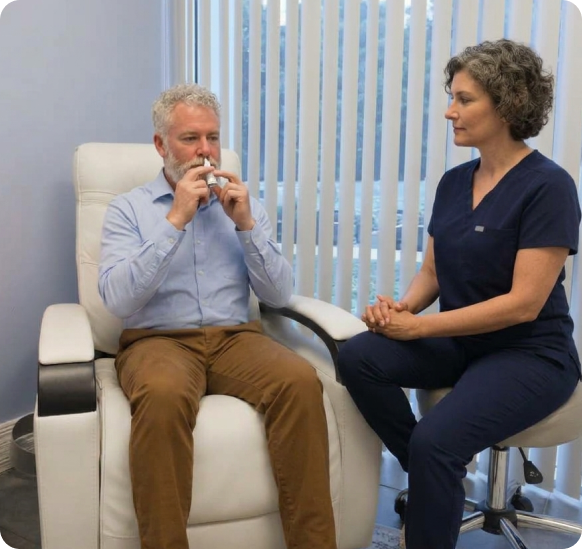
Because esketamine requires exact clinical oversight and controlled delivery, it is administered solely through single-use nasal spray devices in a certified medical environment. It is never dispensed for unmonitored home use.

In-Clinic Treatment Steps and Monitoring
Administering Spravato within a certified healthcare environment ensures consistent safety monitoring throughout the clinical course:
Psychiatric Workup & Historical Audit
Our clinical team reviews psychiatric records, validates previous antidepressant failures, checks concurrent prescriptions, and establishes baseline diagnostic suitability.
Hemodynamic & Physiological Screening
Prior to each dosing session, clinicians verify vital signs, specifically assessing blood pressure to prevent hypertensive complications.
Monitored Self-Administration
Patients self-administer the nasal devices under direct provider observation. Each disposable device provides 28 mg. A standard 56 mg dose requires two devices, whereas an 84 mg dose utilizes three devices, spaced five minutes apart. Induction spans Weeks 1 through 4 with twice-weekly sessions, transitioning to weekly visits across Weeks 5 through 8 based on tolerability.
Clinical Post-Dose Recovery Observation
Patients relax in a comfortable observation suite for at least two hours. Medical personnel routinely monitor blood pressure, dissociation, sedation levels, and respiratory stability until the patient meets all clinical discharge benchmarks.
Coordinated Chaperoned Discharge
Because transient dissociative symptoms, dizziness, and motor slowing can persist temporarily, patients are legally restricted from operating motor vehicles or hazardous machinery until the following calendar day after a restful night of sleep.
Insurance Coverage and Prior Authorization
Obtaining insurance authorization for Spravato for treatment-resistant depression requires clinical documentation demonstrating fulfillment of health plan guidelines:
Insurance carriers typically mandate documented verification of:
A confirmed diagnosis of major depressive disorder without psychotic features.
Chronological pharmacy records validating therapeutic failures across at least two distinct antidepressant classes.
A comprehensive medical-necessity narrative compiled by an attending psychiatric provider.
Formally approved prior authorization clearance prior to clinical administration.
Periodic re-authorizations verifying sustained symptomatic improvement and continued clinical benefit.
Modern Mind Clinic coordinates directly with major commercial plans and government programs, including Medicare, Blue Cross Blue Shield, Aetna, Cigna, and UnitedHealthcare. Our administrative team assists with benefits verification and prior authorization management to clarify potential copayments, coinsurance, or deductible obligations.

For assistance with prior authorization or clinical coverage reviews, call our billing and intake department directly at (248) 213-8655.
Patient Stories
“Modern Mind Clinic gave me the strength to overcome my anxiety. The compassionate psychiatrists and psychiatric nurse practitioners provided unwavering support, and I’ve found a renewed sense of purpose and tranquility in my life.”

“Modern Mind Clinic has been a true lifeline for me during some of my darkest moments. As someone who has battled anxiety and depression for years, finding a mental health clinic near me like Modern Mind Clinic has been a game-changer.”
“The supportive mental health clinic, Modern Mind Clinic, has been an invaluable source of comfort. Knowing that I’m not alone and I can connect with others who truly understand.”
Other Conditions Treated by Modern Mind Clinic
Spravato represents one component of our comprehensive behavioral healthcare services. Modern Mind Clinic provides evidence-based therapies across several distinct diagnostic categories:
Major Depression: Advanced psychiatric assessments, tailored psychopharmacology, and innovative interventional procedures for major depressive episodes.
Anxiety Disorder Treatment: Targeted medical therapies and evidence-based psychotherapy for severe generalized anxiety and panic symptoms.
Panic Disorder Treatment: Structured clinical evaluations and specialized protocols for recurring panic attacks
OCD Treatment: Multimodal psychiatric care and FDA-cleared interventional modalities for persistent obsessive-compulsive symptoms.
PTSD Treatment: Trauma-focused psychiatric interventions and personalized medication regimens for complex post-traumatic stress.
Bipolar Disorder: Diagnostic stabilization, individualized mood-stabilizer management, and ongoing psychiatric supervision
Sleep Disorder: Clinical evaluation and tailored medical management for complex sleep disruptions
ADHD and ADD: Structured adult evaluations and evidence-based medication strategies.
Frequently Asked Questions
Is Spravato FDA-approved for treatment-resistant depression?
Yes. Spravato (esketamine nasal spray) holds official FDA approval for adults diagnosed with treatment-resistant depression. Under current regulatory guidelines, it can be prescribed either as monotherapy or combined with an ongoing oral antidepressant.
How is treatment-resistant depression clinically defined?
Treatment-resistant depression is defined clinically as an ongoing major depressive episode that fails to achieve satisfactory symptom remission following adequate trials of at least two chemically distinct antidepressants taken at therapeutic dosages for appropriate durations.
What does the standard Spravato dosing schedule look like?
The FDA-approved induction schedule for adult treatment-resistant depression requires twice-weekly in-clinic appointments during Weeks 1 through 4. For Weeks 5 through 8, appointments taper to once weekly. From Week 9 onward, maintenance frequency is individualized to once weekly or every two weeks depending on sustained therapeutic stability.
Why is a two-hour clinical observation mandatory after every dose?
Federal Spravato REMS protocols require a minimum two-hour observation period to safeguard patient health. This allows trained clinical staff to track blood pressure changes and ensure that transient side effects—such as sedation, dissociation, and motor slowing—resolve safely before departure.
Can I drive myself home after an esketamine appointment?
No. Operating a motor vehicle, heavy machinery, or engaging in tasks requiring full cognitive acuity is prohibited until the following day after a full night of restful sleep. Patients must arrange reliable transportation home with an adult driver following each appointment.
What are the most common side effects associated with Spravato?
Common temporary effects observed during clinical administration include dissociation, elevated blood pressure, dizziness, nausea, lethargy, vertigo, anxiety, and transient headache. These effects typically peak shortly after administration and resolve within the mandatory two-hour monitoring period.
Can Spravato be taken as a monotherapy without an oral antidepressant?
Yes. Current FDA labeling permits Spravato to be administered as a standalone monotherapy in adult treatment-resistant depression, providing an alternative for patients who cannot tolerate or choose not to take conventional oral antidepressants.
How rapidly does Spravato exert an antidepressant effect?
Unlike traditional antidepressants that take four to eight weeks to manifest noticeable benefits, clinical trials have shown measurable symptom improvements within hours to days following initial esketamine doses. However, individual clinical responses vary.
How does Spravato differ from intravenous racemic ketamine?
Spravato is an FDA-approved prescription nasal spray containing isolated esketamine (the S-enantiomer), dispensed under a regulated REMS safety protocol. Compounded intravenous ketamine consists of a 50:50 racemic mixture of R- and S-enantiomers and lacks formal FDA approval for psychiatric indications.
Does Spravato permanently cure treatment-resistant depression?
No medication provides a permanent cure for major depressive illness. Spravato is an advanced therapeutic option designed to induce and maintain symptom remission, managed through an ongoing clinical care plan.
What do pivotal clinical studies show regarding Spravato efficacy in TRD?
Clinical research demonstrates that esketamine significantly outperforms standard oral regimens in difficult-to-treat cohorts. In the pivotal randomized ESCAPE-TRD trial, 27.1% of patients treated with esketamine nasal spray combined with an oral antidepressant achieved complete remission at Week 8, compared to only 17.6% of patients treated with extended-release quetiapine plus an oral antidepressant (PubMed).
Emergency Notice: Outpatient psychiatric services provided by Modern Mind Clinic do not replace emergency crisis intervention. If you or someone you know is experiencing acute psychiatric distress or thoughts of self-harm, please call 911, visit the nearest emergency room, or call/text the Suicide & Crisis Lifeline at 988.
Contact Us
Our clinic provides a safe and confidential environment for individuals to address their concerns and work towards personal growth.
Ready to Embark on the Journey of Wellness?
Start your mental health transformation with our experienced psychiatric services today. Get to be in your ultimate inner peace and lasting well-being with our programs, tailored to your health needs.