Spravato for Major Depressive Disorder
Living with major depressive disorder can feel exhausting when standard oral medications fail to provide meaningful relief. When chronic numbness, daily mental fog, low energy, and a heavy mood continue to interrupt your personal life and career, finding a different medical direction is an important step forward.
Spravato for major depressive disorder is an FDA-approved nasal spray designed for adults who have not seen adequate progress from multiple standard antidepressant trials or who need rapid support for severe depressive symptoms alongside an oral medication. At Modern Mind Clinic, our team provides intranasal esketamine care in a certified outpatient setting, focusing on physical safety, personal comfort, and close supervision at every visit.
REMS-Certified SPRAVATO® Treatment Center in Southfield, MI
Initial FDA approval granted for esketamine nasal spray to treat adults facing difficult-to-treat depression (PubMed).
Target adult dose range established in landmark clinical studies using individual 28 mg nasal devices (PubMed).
Mandatory clinical monitoring period required by federal REMS guidelines to track vital signs and sedation (NCBI Bookshelf).
Clinical Overview of Major Depression
Major depressive disorder is a complex medical condition that shapes how you think, feel, and handle everyday responsibilities.

It creates persistent shifts in sleep patterns, decision-making, physical stamina, and relationships.
Traditional treatment plans usually start with SSRIs or SNRIs. While these medications help many people, they do not resolve symptoms for everyone. When a person completes two or more separate antidepressant trials at full therapeutic doses without sufficient improvement, doctors identify this pattern as treatment-resistant depression.
Reaching this point does not mean your depression cannot improve. It simply shows that common serotonin pathways are not addressing your biological needs. Spravato offers an FDA-approved option for adults with treatment-resistant depression, available either as a standalone monotherapy or combined with an oral antidepressant, as well as for adults with major depression facing acute suicidal distress.
Who Qualifies for Spravato Treatment
Deciding if Spravato for major depressive disorder is right for you starts with an in-depth medical evaluation by a psychiatric clinician to confirm that treatment is safe and aligned with your goals.
You may qualify for supervised esketamine care if you meet the following clinical criteria:

You have a verified diagnosis of recurrent or severe major depressive disorder.
You meet the standard criteria for treatment-resistant depression after trying at least two different oral antidepressants during your current episode without sufficient relief.
You experience depressive episodes with acute suicidal thoughts or distress that benefit from prompt outpatient symptom management alongside an oral antidepressant.
You can attend scheduled appointments at our certified Spravato REMS clinic, where we provide Spravato in Southfield under direct medical supervision.
You have a trusted adult driver arranged to take you home after each appointment in order to comply with driving restrictions.
You do not have medical conditions that raise safety risks, such as uncontrolled high blood pressure, aneurysmal vascular disease, or a history of brain hemorrhage.
We review your entire psychiatric and physical history before beginning care. Under current FDA rules, eligible adults with treatment-resistant depression can use Spravato as monotherapy, creating a practical path for patients who cannot tolerate the side effects of traditional oral pills.
Daily Life Challenges and Potential Treatment Benefits
Persistent depression touches focus, personal relationships, physical energy, and work performance:
Symptom Domain
Persistent Low Mood
Pervasive Anhedonia
Cognitive Slowing
Profound Exhaustion
Sleep Disruption
Severe Self-Criticism
Social Disengagement
Acute Crises and Suicidal Thoughts
Everyday Functional Obstacle
Lingering heaviness, emotional emptiness, and detachment that make ordinary days feel overwhelming.
Difficulty feeling joy, warmth, or interest in hobbies and time spent with family.
Trouble focusing on tasks, recalling details, and making decisions at your normal pace.
Heavy physical tiredness that turns basic household chores or work duties into difficult tasks.
Trouble falling asleep, waking frequently during the night, or sleeping long hours without feeling rested.
Ongoing guilt, unhelpful self-blame, or feeling like an emotional burden to the people around you.
Pulling away from friends, colleagues, and social gatherings because interaction feels too draining.
Intrusive thoughts of giving up or severe distress that requires prompt clinical attention.
Targeted Clinical Role of Esketamine Care
Rapid glutamatergic signaling aims to encourage mood improvement when standard medications stall.
Synaptogenic pathways are designed to help support the gradual recovery of normal reward responses.
Supporting neural communication is intended to assist with clearer thinking and daily mental focus over time.
Lowering the overall weight of depressive symptoms helps you rebuild daily physical energy.
Balancing central mood systems helps encourage healthier, more dependable sleep routines.
Structured psychiatric care works to interrupt cycles of persistent negative self-judgment.
As heavy depressive feelings ease, spending time with others and engaging in therapy feels more achievable.
Esketamine is FDA-approved to treat depressive symptoms in adults with MDD experiencing acute suicidal ideation.
How Spravato Works in the Brain
Most common antidepressants work slowly by raising levels of serotonin, norepinephrine, or dopamine. Spravato functions through a different neurochemical route by targeting glutamate, the brain’s main chemical messenger for neural activity.
Esketamine blocks NMDA receptors in the brain. This temporary action prompts an immediate release of glutamate, which stimulates nearby AMPA receptors.
When AMPA receptors activate, they trigger internal processes that release brain-derived neurotrophic factor (BDNF) and turn on cellular growth pathways. This sequence supports synaptogenesis, which helps rebuild connections between brain cells in areas that have experienced wear from long periods of depressive stress.
Because esketamine requires exact dosing and professional monitoring, it is provided only in single-use nasal spray devices inside a certified medical clinic. It is never sent home for unsupervised use.

What to Expect During Each In-Clinic Visit
Every Spravato session follows a clear step-by-step clinical routine built around your comfort and health:
Clinical Evaluation and History Review
We review your psychiatric records, confirm past medication trials, check current prescriptions, and make sure esketamine remains the right choice for your treatment plan.
Pre-Dose Health Check
Before every treatment, our clinical team takes your baseline vital signs, focusing on resting blood pressure to confirm you are safe to proceed.
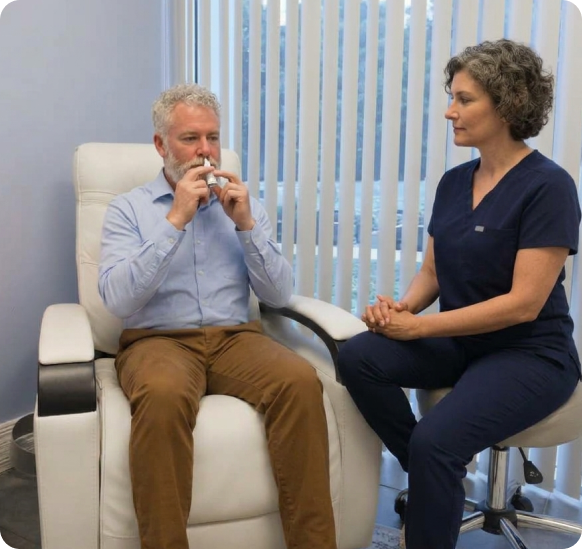
Supervised Self-Administration
You administer the nasal spray yourself while a trained staff member observes. Each device contains 28 mg of medicine. A 56 mg dose uses two devices, while an 84 mg dose uses three, with a five-minute rest between each one. The first phase usually involves two visits per week for Weeks 1 through 4, shifting to once weekly for Weeks 5 through 8 based on how you respond.
Two-Hour In-Clinic Observation
You rest in a comfortable room for at least 120 minutes. Our staff periodically checks your blood pressure, heart rate, and overall comfort while temporary side effects like dizziness or mild dissociation wear off.
Safe Departure with a Driver
Because esketamine causes temporary drowsiness and slower reaction times, you cannot drive yourself home. You must arrange for a responsible adult, such as a family member or friend, to accompany you home, and you must rest until the next morning before driving or operating machinery.
Insurance Verification and Coverage Support
Getting insurance clearance for Spravato for major depressive disorder requires clear medical paperwork showing that you meet your plan’s coverage rules:
Insurers generally ask for documentation confirming:
A diagnosis of recurrent or severe major depressive disorder.
Medical records showing that you did not get adequate relief from at least two different antidepressant trials.
An approved prior authorization before treatment starts.
A clinical treatment note from your psychiatrist explaining why the medication is necessary.
Periodic progress notes confirming that the treatment continues to help you.
Modern Mind Clinic works with major commercial insurers and public programs, including Medicare, Blue Cross Blue Shield, Aetna, Cigna, and UnitedHealthcare. Our administrative team checks your behavioral health and pharmacy benefits directly so you understand your deductibles, copays, or coinsurance before your first visit.

If you have questions about insurance or want help checking your specific benefits, call our intake desk directly at (248) 213-8655.
Patient Stories
“Modern Mind Clinic gave me the strength to overcome my anxiety. The compassionate psychiatrists and psychiatric nurse practitioners provided unwavering support, and I’ve found a renewed sense of purpose and tranquility in my life.”

“Modern Mind Clinic has been a true lifeline for me during some of my darkest moments. As someone who has battled anxiety and depression for years, finding a mental health clinic near me like Modern Mind Clinic has been a game-changer.”
“The supportive mental health clinic, Modern Mind Clinic, has been an invaluable source of comfort. Knowing that I’m not alone and I can connect with others who truly understand.”
Other Conditions Treated by Modern Mind Clinic
Spravato is one part of our outpatient behavioral health practice. Modern Mind Clinic provides evidence-based psychiatric care across several key conditions:
Major Depression: In-depth psychiatric assessments, medication management, therapy, and interventional TMS options for stubborn depressive episodes.
Anxiety Disorder Treatment: Targeted medication plans and evidence-based psychotherapy for persistent generalized anxiety and panic symptoms.
Panic Disorder Treatment: Structured clinical evaluations and practical therapeutic plans to help reduce sudden panic attacks.
OCD Treatment: Psychiatric medication strategies and FDA-cleared options for challenging obsessive-compulsive patterns.
PTSD Treatment: Trauma-focused psychotherapy and individualized medication management for post-traumatic stress.
Bipolar Disorder: Diagnostic evaluations, mood-stabilizing medication plans, and ongoing psychiatric monitoring.
Sleep Disorder: Medical evaluations and structured care plans for chronic sleep disruption.
ADHD and ADD: Comprehensive adult assessments and evidence-based medication strategies.
Frequently Asked Questions About Spravato for Major Depressive Disorder
Is Spravato FDA-approved for major depressive disorder?
Spravato holds FDA approval for two specific uses in adults with major depressive disorder: treatment-resistant depression (used alone as monotherapy or alongside an oral antidepressant) and depressive symptoms in adults with MDD who have acute suicidal thoughts or behavior (used with an oral antidepressant).
How does the FDA define treatment-resistant depression in MDD?
In clinical trials and drug labeling, treatment-resistant depression means an ongoing major depressive episode that has not improved enough after full trials of at least two different oral antidepressants taken at proper doses for adequate time.
Can Spravato be taken as a standalone monotherapy for depression?
Yes. Current FDA labeling allows Spravato to be prescribed on its own without an oral antidepressant for adults with treatment-resistant depression. However, using it for MDD with acute suicidal thoughts still requires taking an oral antidepressant at the same time.
How quickly do patients notice improvements in depressive symptoms?
In clinical trials, measurable symptom improvement appeared as early as 24 hours after the first dose. However, progress happens at a different pace for everyone, and lasting stability develops over weeks of consistent treatment.
What are the most common side effects associated with Spravato?
Common temporary reactions include mild dissociation, sleepiness, dizziness, nausea, headache, vertigo, a brief rise in blood pressure, and transient anxiety. These sensations usually peak shortly after taking the spray and fade within the two-hour observation period.
Why is clinical monitoring required after every dose?
Federal REMS safety rules require every patient to stay under medical supervision for at least two hours after each dose. This allows our staff to track your blood pressure, ensure you feel steady on your feet, and confirm it is safe for you to leave.
Can I drive home after receiving Spravato?
No. Because esketamine causes temporary changes in perception, reaction time, and alertness, you cannot drive or run machinery until the following day after a full night of sleep. You must arrange a ride home with a driver before every appointment.
Does Spravato permanently cure major depressive disorder?
No medication offers a permanent cure for major depressive disorder. Spravato is designed to reduce heavy symptoms and support lasting remission as part of an ongoing psychiatric care plan.
How does Spravato differ from intravenous racemic ketamine?
Spravato is an FDA-approved nasal spray containing isolated esketamine (the S-enantiomer), dispensed through a strict REMS program. Compounded IV ketamine contains a 50:50 mixture of R- and S-enantiomers and is not FDA-approved to treat depression.
Does Spravato prevent or stop suicidal thoughts?
While Spravato is approved to treat depressive symptoms in adults with MDD experiencing acute suicidal distress, studies have not shown that it prevents suicide or stops suicidal behavior. Outpatient treatment does not replace emergency hospital care if you need immediate crisis stabilization.
Emergency Notice: Outpatient mental health care at Modern Mind Clinic does not replace emergency crisis intervention. If you or someone you know is facing an acute mental health emergency or thoughts of self-harm, call 911, go to the nearest emergency room, or call or text the Suicide & Crisis Lifeline at 988.
Contact Us
Our clinic provides a safe and confidential environment for individuals to address their concerns and work towards personal growth.
Ready to Embark on the Journey of Wellness?
Start your mental health transformation with our experienced psychiatric services today. Get to be in your ultimate inner peace and lasting well-being with our programs, tailored to your health needs.