
Spravato for Depression
When depression continues despite adequate treatment with standard antidepressants, symptoms can begin to affect nearly every part of daily life.
Spravato (esketamine) offers a different treatment approach for adults with treatment-resistant depression, with administration performed in a supervised clinical setting rather than at home. Modern Mind Clinic provides comprehensive psychiatric evaluation, monitored Spravato administration, and ongoing treatment planning for eligible adults.
REMS-Certified SPRAVATO® Treatment Center in Southfield, MI
Minimum post-dose clinical monitoring period required under the Spravato REMS program (NCBI Bookshelf).
Standard induction frequency during the first 4 weeks of care for adult treatment-resistant depression (NCBI Bookshelf).
Controlled medication requiring administration and observation within a certified healthcare setting (NCBI Bookshelf).
What Is Treatment-Resistant Depression?
Treatment-resistant depression (TRD) refers to major depressive disorder that has not improved adequately after appropriate antidepressant treatment.

In clinical practice, treatment history is reviewed carefully because an inadequate response can result from multiple factors, including medication selection, dose, duration, adherence, side effects, and the severity or complexity of the depressive episode.
Spravato contains esketamine, the S-enantiomer of ketamine. Unlike conventional antidepressants that primarily influence serotonin or norepinephrine signaling, esketamine acts on the brain’s glutamate system as an NMDA receptor antagonist. This produces downstream changes in glutamatergic signaling and synaptic plasticity that may contribute to its antidepressant effects.
For adults with treatment-resistant depression, Spravato is FDA-approved as monotherapy or in combination with an oral antidepressant. A separate FDA-approved indication covers depressive symptoms in adults with major depressive disorder accompanied by acute suicidal ideation or behavior, where Spravato is used alongside an oral antidepressant.
The medication is not a substitute for emergency psychiatric care, and its use does not establish that hospitalization can be avoided when acute safety concerns are present.
Who Is a Candidate for Spravato?
Spravato is not appropriate for every person with depression. Eligibility requires an in-depth psychiatric assessment that evaluates diagnosis, previous treatment response, current symptoms, medical history, concurrent medications, blood pressure, substance-use risk, and other vital safety factors:
A patient may be considered for Spravato treatment when clinical evaluation supports:

A confirmed diagnosis of major depressive disorder with inadequate response to prior antidepressant therapies.
A clinical treatment history consistent with treatment-resistant depression.
Persistent depressive symptoms despite compliant medication management.
Previous antidepressant trials that were ineffective, inadequately effective, or poorly tolerated.
The physical ability to attend in-clinic sessions and remain under direct observation post-administration.
No medical or psychiatric contraindications that would render esketamine administration unsafe.
Full willingness to follow mandatory Spravato REMS monitoring and post-treatment transportation rules.
Pivotal clinical trials supporting the treatment-resistant depression indication evaluated adults who did not respond adequately to at least two different antidepressants during their current depressive episode. Insurance criteria often reflect these benchmarks, making prior authorization verification essential before initiating care.Our team handles this process for patients seeking Spravato in Southfield.
Spravato may also be considered under its separate FDA-approved indication for adults with major depressive disorder and acute suicidal ideation or behavior. Because suicidal thoughts and behaviors represent a clinical emergency, evaluation determines whether outpatient Spravato is appropriate or if acute inpatient stabilization is necessary.
How Depression Can Affect Daily Life
Depression can persist even when an individual continues working, attending school, managing a household, or maintaining social obligations. Symptoms often manifest through gradual changes in motivation, cognitive processing, sleep architecture, personal relationships, and hedonic capacity:
Symptom Domain
Persistent Low Mood
Loss of Interest (Anhedonia)
Low Motivation & Fatigue
Cognitive Difficulty
Sleep Disturbance
Feelings of Worthlessness
Social Withdrawal
Suicidal Thoughts
Common Daily Impact
Pervasive sadness, emptiness, hopelessness, or emotional heaviness that impairs routine functioning
Previously meaningful hobbies and activities feel unrewarding or require severe effort to initiate.
Routine household responsibilities, employment duties, and personal hygiene feel disproportionately exhausting.
Impaired focus, mental fog, indecision, and task fragmentation that disrupt work or academic performance.
Persistent insomnia, fragmented nighttime sleep, or excessive daytime sleeping (hypersomnia).
Unwarranted guilt, severe self-criticism, or a chronic sense of failure that reinforces depressive spirals.
Progressive avoidance of family, isolation from peers, and difficulty maintaining interpersonal connections.
Severe thoughts of death requiring immediate clinical intervention and acute risk management.
How Spravato Treatment May Help
Esketamine produces glutamatergic effects that can contribute to downstream antidepressant activity.
Care is designed to support the reduction of depressive symptoms and help restore motivation.
General symptom reduction may make day-to-day responsibilities significantly more manageable over time.
Alleviating depressive burdens can contribute to improved mental clarity and executive functioning.
Regulating underlying depressive episodes may help normalize disruptive sleep patterns gradually.
Targeted psychiatric treatment may reduce the severity and frequency of intrusive negative thought patterns.
Gradual mood stabilization may help patients re-engage socially and rebuild relational support systems.
Spravato carries an FDA-approved indication for acute suicidal ideation, though it does not prevent suicide or replace emergency crisis care.
How Spravato Works
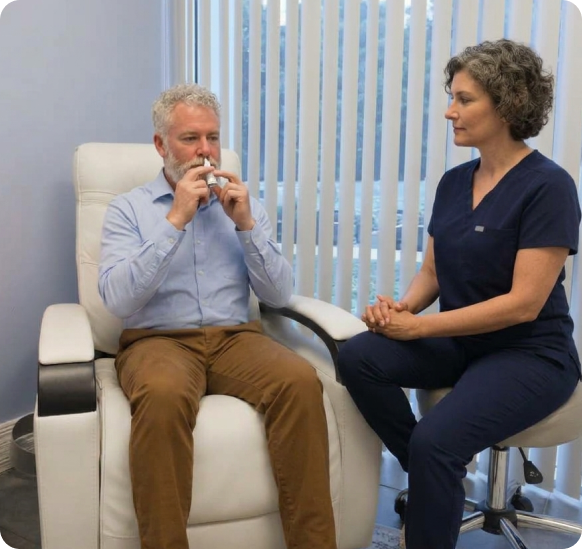
Spravato is administered intranasally as an esketamine spray. Following administration, esketamine is absorbed directly across the nasal mucosa to enter the bloodstream and cross the blood-brain barrier.
Its primary mechanism involves the antagonism of N-methyl-D-aspartate (NMDA) receptors within the glutamate pathways. This blockade triggers a transient surge in glutamate release, subsequently activating alpha-amino-3-hydroxy-5-methyl-4-isoxazolepropionic acid (AMPA) receptors. This cascade stimulates neurotrophic signaling pathways, promoting synaptogenesis and restoring neural connectivity in regions associated with emotional regulation.
Spravato does not operate like conventional selective serotonin reuptake inhibitors (SSRIs) or serotonin-norepinephrine reuptake inhibitors (SNRIs). By addressing glutamatergic pathways rather than monoamine systems, it offers a separate pharmacological modality for individuals whose depression has not responded to traditional oral therapies.

What to Expect During a Spravato Treatment Course
Because Spravato is a Schedule III controlled substance associated with transient dissociative and sedative effects, administration occurs strictly within a certified healthcare environment under medical supervision:
Comprehensive Psychiatric Consultation
The clinical team reviews historical psychiatric diagnoses, previous medication trials, current prescriptions, medical conditions, and therapeutic objectives to confirm clinical candidacy.
Pre-Treatment Safety Assessment
Before each session, clinicians assess vital signs (including baseline blood pressure), cardiovascular health, and potential contraindications to confirm safe administration.
Supervised Self-Administration
Under medical observation, the patient self-administers the nasal spray devices. For treatment-resistant depression, the FDA-labeled induction protocol consists of twice-weekly sessions during Weeks 1 through 4 at either 56 mg or 84 mg, adjusted for clinical tolerance.
Clinical Post-Dose Observation
Patients remain in a quiet, comfortable treatment room for at least two hours. Clinicians monitor vital signs and observe for transient adverse events, including sedation, dissociation, blood pressure elevations, and respiratory stability.
Ongoing Treatment & Maintenance Planning
During Weeks 5 through 8, administration typically tapers to once weekly. From Week 9 onward, frequency is individualized to once weekly or every two weeks based on sustained clinical response.
Safety Warning: Patients are strictly prohibited from driving, operating heavy machinery, or engaging in tasks requiring complete cognitive alertness until the following day after a restful night of sleep. Reliable transportation must be arranged prior to every appointment.
Insurance and Coverage for Spravato
Spravato coverage is determined by individual health plans, verified psychiatric diagnoses, detailed treatment history, and prior authorization requirements. Approval requires documentation showing that specific clinical guidelines have been fulfilled:
Insurers typically require documentation demonstrating:
A formal diagnosis of major depressive disorder.
Medical records verifying treatment resistance (inadequate response to at least two different antidepressants at therapeutic doses and durations).
Comprehensive psychiatric assessment and physician statement of medical necessity.
Active prior authorization approval before starting treatment.
Periodic clinical updates validating continued therapeutic response and ongoing medical necessity.
Modern Mind Clinic assists patients directly with benefits verification, prior authorization processing, and transparent cost estimations prior to scheduling. The clinic works with major commercial and public insurance networks, including Medicare, Blue Cross Blue Shield, Aetna, Cigna, and UnitedHealthcare.

For current eligibility criteria, coverage questions, or personal cost estimates, contact our administrative team directly at (248) 213-8655.
Patient Stories
“Modern Mind Clinic gave me the strength to overcome my anxiety. The compassionate psychiatrists and psychiatric nurse practitioners provided unwavering support, and I’ve found a renewed sense of purpose and tranquility in my life.”

“Modern Mind Clinic has been a true lifeline for me during some of my darkest moments. As someone who has battled anxiety and depression for years, finding a mental health clinic near me like Modern Mind Clinic has been a game-changer.”
“The supportive mental health clinic, Modern Mind Clinic, has been an invaluable source of comfort. Knowing that I’m not alone and I can connect with others who truly understand.”
Other Conditions Treated by Modern Mind Clinic
Spravato is one component of our psychiatric service offerings. Modern Mind Clinic provides evidence-based care across an array of behavioral health conditions:
Major Depression: Advanced psychiatric evaluations, medication management, and interventional therapies for chronic and major depressive episodes.
Anxiety Disorder Treatment: Comprehensive treatment protocols for generalized anxiety, panic symptoms, and social anxiety.
Panic Disorder Treatment: Targeted clinical care and evidence-based interventions to manage recurrent panic attacks.
OCD Treatment: Specialized medical management and FDA-cleared interventional modalities for persistent obsessive-compulsive symptoms.
PTSD Treatment: Trauma-informed psychiatric care and targeted pharmacotherapy for post-traumatic stress.
Bipolar Disorder: Diagnostic evaluations, mood-stabilizing medication plans, and routine psychiatric support.
Sleep Disorder: Clinical evaluation and tailored management strategies for chronic sleep-related difficulties.
ADHD and ADD: Formal adult evaluations and structured medication management strategies.
Frequently Asked Questions About Spravato for Depression
What is Spravato for depression?
Spravato is the brand name for esketamine nasal spray. It is an FDA-approved prescription medication indicated for adults with treatment-resistant depression and for depressive symptoms in adults with major depressive disorder accompanied by acute suicidal ideation or behavior, administered under REMS clinical supervision.
Is Spravato the same as ketamine?
No. Spravato contains esketamine, which is the purified S-enantiomer of ketamine, formulated and FDA-approved specifically for psychiatric use as a nasal spray. Racemic intravenous ketamine contains both R- and S-enantiomers and is not FDA-approved as a psychiatric treatment.
How quickly does Spravato work for depression?
Clinical trials have demonstrated measurable improvements in depressive symptoms within 24 hours of administration for some patients. However, individual response rates vary, and several weeks of consistent induction therapy may be required to achieve full therapeutic benefit.
How often is Spravato administered?
For adult treatment-resistant depression, the induction protocol requires twice-weekly visits during Weeks 1 through 4. Maintenance treatment generally reduces to once weekly for Weeks 5 through 8, and subsequently adjusts to once weekly or every other week based on symptom stability.
How long do I stay at the clinic after Spravato?
Patients must remain under in-clinic medical observation for a minimum of two hours following administration. This observation window ensures clinical staff can monitor blood pressure, assess dissociative symptoms, and ensure stability prior to discharge.
What does Spravato feel like during administration?
Many individuals experience temporary sensations of dissociation, altered sensory perception, floating, mild dizziness, or sedation during the observation period. These transient effects peak quickly and generally resolve within the mandatory two-hour monitoring timeframe.
Can Spravato be taken alongside an oral antidepressant?
Yes. For treatment-resistant depression, Spravato is FDA-approved for use either as monotherapy or in conjunction with an ongoing oral antidepressant. Your psychiatrist will evaluate your current medication regimen to formulate an individualized plan.
Is Spravato covered by private health insurance?
Most major commercial health plans and Medicare provide coverage for Spravato when specific medical necessity and prior authorization guidelines for treatment-resistant depression are satisfied. Modern Mind Clinic coordinates insurance verifications prior to treatment.
Can I drive myself home after a treatment session?
No. Operating motor vehicles or heavy machinery is strictly contraindicated until the following calendar day after a restful night of sleep. Patients must arrange for a trusted driver or alternative transportation to leave the clinic.
Does Spravato treat suicidal thoughts?
Spravato carries an FDA-approved indication for depressive symptoms in adults with major depressive disorder accompanied by acute suicidal ideation or behavior when used alongside an oral antidepressant. However, it has not been demonstrated to prevent suicide or eliminate suicidal behavior. Anyone experiencing an immediate life-threatening crisis should seek emergency medical attention or dial 988.
Emergency Notice: Outpatient psychiatric services provided by Modern Mind Clinic do not replace emergency crisis intervention. If you or someone you know is experiencing acute psychiatric distress or thoughts of self-harm, please call 911, visit the nearest emergency room, or call/text the Suicide & Crisis Lifeline at 988.
Contact Us
Our clinic provides a safe and confidential environment for individuals to address their concerns and work towards personal growth.
Ready to Embark on the Journey of Wellness?
Start your mental health transformation with our experienced psychiatric services today. Get to be in your ultimate inner peace and lasting well-being with our programs, tailored to your health needs.