
Spravato for Anxiety
Persistent anxiety can make routine daily activities feel exhausting. When excessive worry, muscle tension, racing thoughts, and depressive mood continue despite standard therapies, many adults begin exploring alternatives beyond oral anxiolytics.
Spravato (esketamine nasal spray) is primarily evaluated when debilitating anxiety co-occurs with treatment-resistant depression (TRD). It is not FDA-approved as a standalone treatment for primary anxiety disorders; however, clinical research suggests that anxiety symptoms may decrease significantly when individuals receive supervised esketamine therapy for underlying treatment-resistant depressive illness.
REMS-Certified SPRAVATO® Treatment Center in Southfield, MI
Mandatory in-clinic monitoring duration required after each esketamine administration under the Spravato REMS framework (NCBI Bookshelf).
Standard induction administration frequency throughout the initial 4-week protocol for adult treatment-resistant depression (NCBI Bookshelf).
Percentage of participants in a long-term TRD cohort demonstrating measurable reductions in anxiety severity following extended intranasal esketamine therapy (PubMed).
What Is the Role of Spravato for Anxiety?
Spravato is an esketamine nasal formulation engineered to modulate central glutamate neurotransmission via non-competitive NMDA receptor antagonism.

Public search interest often diverges from established regulatory parameters. Spravato holds official FDA-approved indications for adults diagnosed with treatment-resistant depression (as monotherapy or adjunct to oral antidepressants) and major depressive disorder accompanied by acute suicidal ideation or behavior. Standalone anxiety conditions, including generalized anxiety disorder (GAD), panic disorder, and social phobia, are not distinct FDA-approved indications.
Despite these formal parameters, clinical trials document a meaningful crossover. In a randomized clinical investigation involving adults with treatment-resistant depression, approximately 72% of participants presented with clinically significant comorbid anxiety. Esketamine demonstrated sustained therapeutic improvements in depressive severity irrespective of concurrent baseline anxiety levels. (Pubmed).
For individuals experiencing both conditions, clinical differentiation is essential. A comprehensive psychiatric evaluation determines whether persistent anxious distress stems from a primary anxiety disorder or represents an anxious distress feature within an unyielding depressive episode.
Who May Be a Candidate for Spravato?
Because Spravato is not a primary intervention for isolated anxiety, candidacy requires a formal psychiatric diagnostic workup to verify an FDA-approved depressive condition:
A patient may be considered for clinic-administered Spravato when they:

Present with confirmed major depressive disorder that has not responded adequately to at least two different oral antidepressants.
Experience significant, persistent anxiety symptoms secondary to, or co-occurring with, treatment-resistant depression.
Have explored established frontline interventions, including SSRIs, SNRIs, and structured psychotherapy.
Can attend scheduled in-person appointments at a certified REMS outpatient facility.
Have dependable transportation arranged, strictly adhering to the post-treatment driving restriction.
Show no clinical contraindications (such as aneurysmal vascular disease or uncontrolled hypertension) that compromise esketamine safety.
Therapeutic decisions are never based on self-reported anxiety severity alone. Our psychiatric team conducts a comprehensive diagnostic review, evaluating physiological history, baseline blood pressure, prior pharmacological trials, and current medications, to determine clinical safety and appropriateness.
How Co-Occurring Anxiety and Depression Affect Daily Functioning
Anxiety rarely presents as isolated cognitive worry. When intertwined with treatment-resistant depression, it frequently manifests as somatic strain, autonomic hyperarousal, severe cognitive fragmentation, and emotional exhaustion:
Symptom Domain
Persistent Worry
Racing Thoughts
Physical Tension
Sleep Disruption
Heightened Irritability
Concentration Impairment
Motivational Paralysis
Pervasive Hopelessness
Common Functional Impact
Repetitive cognitive fixation on impending difficulties, mistakes, or catastrophic outcomes.
Accelerated internal cognition that disrupts task completion and causes severe mental fatigue.
Muscle rigidity, clenching, chronic headaches, and persistent physical restlessness.
Severe onset insomnia, recurring nighttime awakenings, or unrefreshing sleep architecture.
Reduced emotional tolerance for minor daily stressors and relational friction.
Inability to maintain focus during work, reading, conversations, or complex decision-making.
An absence of psychological energy to execute daily routines or manage anxious feelings.
A debilitating conviction that chronic anxiety and depressive exhaustion will never lift.
Potential Clinical Role of Esketamine Care
Targeted glutamatergic signaling may help disrupt persistent rumination secondary to depressive illness.
Modulating synaptic plasticity is designed to support calmer cognitive processing over time.
Overall reduction in central nervous system hyperarousal can contribute to physical relief.
Relieving underlying depressive and anxious distress may gradually help normalize healthy sleep rhythms.
Stabilizing mood regulation circuits can help restore everyday emotional equilibrium.
Synaptic recovery in prefrontal networks can contribute to improved executive functioning.
Symptom reduction may restore the behavioral activation needed to resume basic daily tasks.
Rapid neurotrophic activation may help alleviate deep-seated depressive distress.
How Does Spravato Work in the Brain?
Spravato contains esketamine, the purified S-enantiomer of ketamine. Rather than directly raising monoamine availability like conventional SSRIs or SNRIs, it operates as a non-competitive antagonist at N-methyl-D-aspartate (NMDA) receptors within brain glutamate circuits.
Glutamate serves as the brain’s principal excitatory neurotransmitter. By transiently inhibiting NMDA receptors, esketamine initiates a cascade that stimulates alpha-amino-3-hydroxy-5-methyl-4-isoxazolepropionic acid (AMPA) receptors. This downstream surge stimulates brain-derived neurotrophic factor (BDNF) release and activates mammalian target of rapamycin (mTOR) pathways, promoting synaptogenesis in neural circuits compromised by chronic stress.
While its antidepressant pharmacodynamics are extensively mapped, anxiety-specific pathways remain an area of ongoing scientific investigation. Clinical data suggests that reductions in anxious symptoms often occur downstream from general depressive improvement, rather than through standalone anxiolytic mechanisms.

What to Expect During Spravato Treatment
Spravato administration follows a strict clinical protocol designed to ensure physiological safety and comfort:
Psychiatric Evaluation & Diagnostic Confirmation
Your care begins with a full evaluation at our clinic offering Spravato in Southfield.
Individualized Treatment Planning
If cleared, your clinician establishes the dosing titration schedule and reviews essential REMS parameters, including potential dissociative effects, vitals tracking, and mandatory driver coordination.
Supervised Nasal Administration
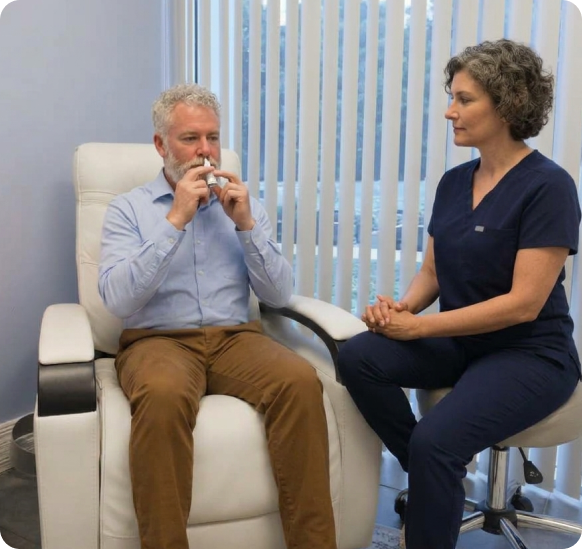
Patients self-administer the nasal spray under direct medical oversight. Induction begins at twice weekly for Weeks 1 through 4 (utilizing 56 mg or 84 mg), transitioning to once weekly during Weeks 5 through 8 based on clinical tolerance.
Clinical Post-Dose Observation
Patients remain in a quiet, supervised outpatient room for a minimum of two hours. Medical staff evaluate blood pressure before and after dosing while continuously assessing for transient sedation, dissociation, or blood-pressure elevation.
Safe Discharge Protocol
Because esketamine can temporarily impair motor coordination and cognitive processing, patients may never drive themselves home. Patients must avoid operating machinery or participating in hazardous activities until the following calendar day after a restful night of sleep.
Insurance Verification and Coverage Considerations
Insurance coverage for Spravato is governed by strict medical-necessity criteria and carrier-specific prior authorization rules:
Because primary anxiety disorders are not FDA-approved indications for Spravato, insurance approval requires documentation demonstrating that the patient meets criteria for an FDA-approved condition, such as treatment-resistant depression.
Insurers typically require documentation of:
A confirmed diagnosis of major depressive disorder with persistent symptoms.
Verified records of inadequate response or intolerance to at least two distinct antidepressant trials.
A comprehensive psychiatric evaluation detailing the medical necessity of interventional care.
Active, approved prior authorization before treatment initiation.
Scheduled clinical documentation demonstrating ongoing treatment response.

Modern Mind Clinic assists patients directly with prior authorization paperwork and comprehensive benefits checks across networks including Medicare, Blue Cross Blue Shield, Aetna, Cigna, and UnitedHealthcare.
To verify personal coverage or request a cost evaluation, call our clinical intake desk directly at (248) 213-8655.
Patient Stories
“Modern Mind Clinic gave me the strength to overcome my anxiety. The compassionate psychiatrists and psychiatric nurse practitioners provided unwavering support, and I’ve found a renewed sense of purpose and tranquility in my life.”

“Modern Mind Clinic has been a true lifeline for me during some of my darkest moments. As someone who has battled anxiety and depression for years, finding a mental health clinic near me like Modern Mind Clinic has been a game-changer.”
“The supportive mental health clinic, Modern Mind Clinic, has been an invaluable source of comfort. Knowing that I’m not alone and I can connect with others who truly understand.”
Other Conditions Treated by Modern Mind Clinic
Spravato forms one branch of our comprehensive behavioral health services. Modern Mind Clinic provides evidence-based treatments across multiple specialized areas:
Major Depression: Advanced psychiatric assessments, medication management, and interventional therapies for recurrent and treatment-resistant depressive disorders.
Anxiety Disorder Treatment: Evidence-based medical management and psychotherapy for generalized anxiety, social anxiety, and chronic worry.
Panic Disorder Treatment: Structured pharmacological and interventional care designed to target recurring panic attacks.
OCD Treatment: Comprehensive clinical strategies and FDA-cleared adjunct options for obsessive-compulsive patterns.
PTSD Treatment: Trauma-informed psychiatric care and specialized medical management for trauma-related conditions.
Bipolar Disorder: Diagnostic clarity, mood-stabilizing medication plans, and ongoing psychiatric monitoring.
Sleep Disorder: Clinical evaluation and tailored medical management for complex sleep disruptions
ADHD and ADD: Formal psychiatric evaluations and personalized medication management strategies.
Frequently Asked Questions About Spravato for Anxiety
Is Spravato FDA-approved for anxiety?
No. Spravato is not FDA-approved as a standalone therapy for generalized anxiety disorder, social anxiety, panic disorder, or isolated anxiety conditions. Its regulatory indications are restricted to treatment-resistant depression and major depressive disorder accompanied by acute suicidal ideation or behavior.
Can Spravato reduce anxiety symptoms?
Spravato may contribute to symptom reduction when significant anxiety co-occurs with treatment-resistant depression. Clinical evidence shows that as underlying depressive severity improves, comorbid anxiety scores often decline; however, it is not prescribed as a monotherapy for anxiety alone.
Does Spravato Work for Anxiety?
Some clinical studies suggest Spravato (esketamine) may help ease anxiety symptoms, especially in people who also have major depressive disorder. However, the FDA has not approved Spravato to treat anxiety or anxiety disorders.
Can I receive Spravato if I have generalized anxiety disorder?
A diagnosis of GAD alone does not fulfill clinical or insurance criteria for Spravato. However, if a qualified psychiatric evaluation confirms that you also suffer from treatment-resistant depression, a psychiatrist may evaluate whether Spravato is clinically indicated for the depressive illness while managing anxiety concurrently.
How quickly does Spravato demonstrate therapeutic effects?
In clinical trials for depression, statistically significant symptom separation has been observed within hours to days following administration. However, individual response varies considerably, and improvements in secondary anxiety may follow a distinct timeline.
How often are Spravato treatments administered?
For adult treatment-resistant depression, standard induction requires two in-clinic visits per week during Weeks 1 through 4. Maintenance frequency typically decreases to once weekly for Weeks 5 through 8, moving to once weekly or every other week thereafter.
Why is a two-hour clinical observation window mandatory?
Esketamine administration carries risks of transient sedation, dissociation, blood pressure spikes, and respiratory depression. The FDA REMS protocol mandates continuous in-clinic monitoring for at least two hours until vital signs and cognitive stability return to baseline.
Can I drive myself home following treatment?
No. Esketamine temporarily impairs executive functioning, motor reflexes, and alertness. Patients are strictly prohibited from driving or operating machinery until the following calendar day after a restful night of sleep.
Is Spravato the same as intravenous ketamine infusion?
No. Spravato is an FDA-approved proprietary, single-enantiomer (esketamine) nasal spray governed by specific FDA regulations and REMS dispensing controls. Intravenous ketamine consists of a racemic mixture (both R- and S-enantiomers) and is not FDA-approved for psychiatric indications.
What treatments are available if anxiety is my primary condition?
If a clinical evaluation demonstrates that anxiety is your primary diagnosis without treatment-resistant depression, our clinicians typically recommend established first-line interventions, including specialized psychotherapy, SSRIs, SNRIs, or targeted TMS protocols.
Does the Modern Mind Clinic offer Spravato administration?
Yes. Modern Mind Clinic is a certified REMS treatment center providing monitored Spravato administration alongside comprehensive psychiatric evaluations, medication management, psychotherapy, and interventional TMS therapy.
Emergency Notice: Outpatient psychiatric services provided by Modern Mind Clinic do not replace emergency medical or crisis services. If you are experiencing acute psychiatric distress or immediate thoughts of self-harm, please dial 911, report to the nearest emergency department, or contact the Suicide & Crisis Lifeline at 988.
Contact Us
Our clinic provides a safe and confidential environment for individuals to address their concerns and work towards personal growth.
Ready to Embark on the Journey of Wellness?
Start your mental health transformation with our experienced psychiatric services today. Get to be in your ultimate inner peace and lasting well-being with our programs, tailored to your health needs.